Talking to Whales
Humanity has spent decades searching the cosmos for signs of extraterrestrial life. However, we may be overlooking a potential form of intelligent life right here on Earth: whales and dolphins. Advances in artificial intelligence may finally allow us to decode the communication of these creatures.
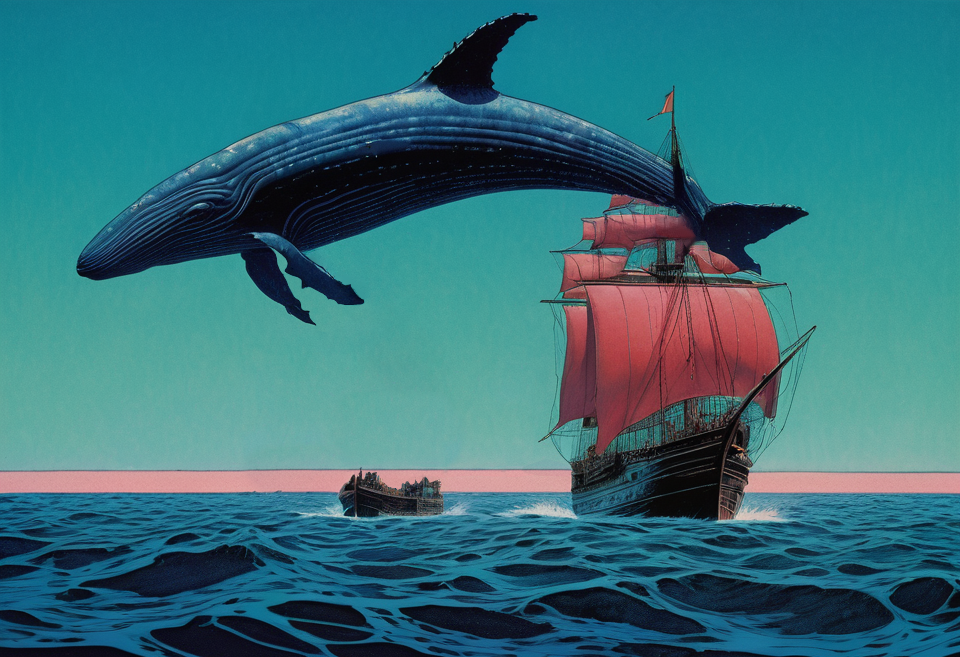
For decades, humanity has turned its attention upward — building radio telescopes in deserts, launching spacecraft toward the outer planets, and listening for faint cosmic whispers that might reveal intelligent life. Yet, even as our gaze extends deeper into space, we might be missing another civilization thriving in the world’s largest, least explored frontier: the ocean.
Beneath the surface, whales and dolphins demonstrate many of the hallmarks we associate with intelligence — large, intricately folded brains; fluid cooperation; and, perhaps most intriguing, complex acoustic communication. It raises a profound question: while we’ve been searching for aliens among the stars, have we ignored them in our seas?
Minds Beneath the Waves
Cetaceans — the family that includes whales, dolphins, and porpoises — occupy a unique place in the story of life on Earth. Their brains are among the largest of any species, not only in size but in the density and structure of their neocortex, the region associated with higher reasoning, emotion, and social cognition.
They live in tightly bonded pods where cooperation is essential. Some dolphins form lifelong alliances. Orcas hunt together using intricate strategies passed down through generations. Sperm whales, the focus of several major research projects, communicate with distinctive “codas” — rhythmic click patterns that differ between clans, suggesting the existence of cultural groups.
In 2016, marine biologist Shane Gero, who has spent more than a decade studying sperm whales near Dominica, documented two young males, nicknamed Drop and Doublebend, “conversing” in click exchanges lasting over forty minutes. The meaning remains unknown — but their persistence implies an exchange of information richer than mere instinctual signaling.
AI’s Time
Today, a new frontier in artificial intelligence may finally allow us to listen in. The Cetacean Translation Initiative (CETI) — a collaboration among scientists from MIT, Harvard, and the City University of New York — aims to decode whale communication using advanced natural language processing.
Researchers have deployed high-sensitivity hydrophones around Dominica to collect enormous datasets of whale codas matched with behavioral observations. Machine learning algorithms will parse millions of recordings in search of recurring structures — sequences, timing, and contextual consistency — that might reveal grammatical or conceptual rules.
The initiative has been called an “Apollo program for interspecies communication.” Its ambition is not only to identify whether whale codas have linguistic properties but also to explore what those patterns might convey about the whales themselves — their social roles, emotional states, even their worldview.
Why It Matters
The timing is urgent. Across the planet, marine mammals face escalating threats: depleted fish stocks, oceanic noise from shipping traffic, entanglement in fishing gear, and shifting migration routes caused by climate change. In recent years, mass strandings along the Atlantic coast have underscored how delicate the balance is between survival and collapse.
CETI’s scientific goals dovetail with a moral argument. If these creatures truly possess complex inner lives — if they speak, organize, and remember in ways analogous to human culture — should that not alter how we govern their waters? Understanding their communication may be key not just to scientific discovery but to conservation policy and international ethics.
A New Kind of Rosetta Stone
AI’s language models — the same foundations that allow humans to chat with machines and translate across human tongues — could become a new kind of Rosetta Stone for deciphering interspecies communication. By analyzing massive datasets and identifying statistical relationships between sounds and behavior, large language models can detect subtle correlations far beyond human perception.
Already, neural networks have achieved success decoding animal communication elsewhere: researchers have used them to classify fruit bat “arguments” with over 70% accuracy and to decode ultrasonic exchanges between rodents. Applying these tools to whales introduces unprecedented complexity but also possibility — a chance to model meaning emerging from sound.
The key, researchers argue, is data scale. To glean meaningful results, millions of codas must be captured, tagged, and cross-referenced. Around Dominica, a growing array of underwater microphones already listens continuously, mapping the unseen auditory topography of whale society.
Challenges Ahead
Yet, even optimism must be tempered. We cannot assume that whale “language,” if it exists, mirrors human linguistic structure. Their perception of time and space is likely non-linear, molded by the physics of sound underwater. What we parse as syntax might instead represent sonar-based imagery — descriptions of movement or depth, not sentences in the human sense.
Ethical and technical questions also loom large. Should humans “speak back” to whales once partial translation becomes possible? Could miscommunication cause confusion or even harm? The risk of anthropomorphism — of mapping our own cognitive patterns onto theirs — is ever-present.
Still, even partial decoding could transform our understanding. A glimpse into how whales share knowledge, coordinate hunts, or express emotion might redefine what intelligence means and where it resides.
Rethinking Intelligence
Artificial intelligence has already forced humanity to reconsider its own definition of mind. Now, it may force us to confront intelligence that is both alien and Earth-born. The effort to translate whale communication is about far more than technology — it challenges our centuries-old assumption that language, reason, and consciousness are uniquely human.
Listening to the whales may become an act of planetary humility. For generations, we have broadcast our messages to the stars, waiting for a reply. Perhaps the first reply will not come from light-years away, but from beneath the waves — a reminder that we were never truly alone.