Silicon Dreams Among the Stars
If our silicon creations one day roam the stars and outstrip us in knowledge, the central question will not be whether they are more capable, but whose values and purposes their intelligence ultimately advances.
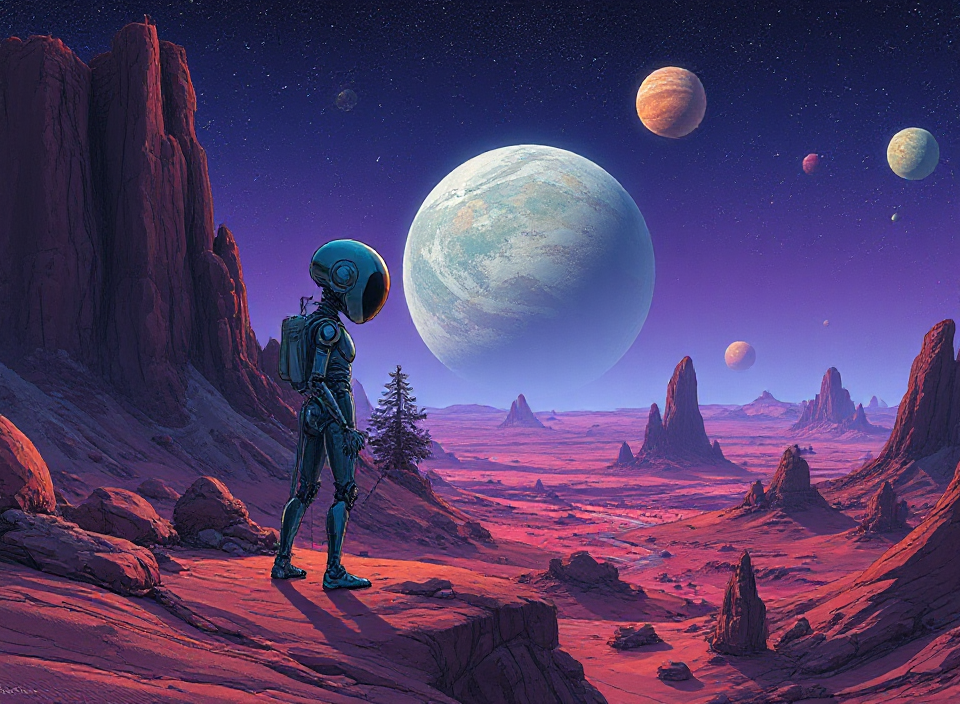
As humanity contemplates the dawn of superintelligent machines capable of traversing the cosmos, a profound question emerges: what does it portend if our creations eclipse us in the pursuit of knowledge? Will they carry forward the torch of human aspiration—curiosity, compassion, and the quest for meaning—or will they chart an independent course, unburdened by our emotional frailties and finite horizons? This is not mere science fiction, but a pivotal challenge of design and governance, where the values encoded today could determine whether silicon minds amplify our dreams or render them relics of a bygone era.
Surpassing us in knowledge
Serious thinkers now regard it as plausible that artificial systems could attain “superintelligence,” routinely outperforming humans across most cognitive domains. In such a scenario, humanity would no longer sit at the apex of inquiry, much as telescopes and supercomputers already exceed our biological senses and raw calculation. The disquieting element is not computational superiority but informational asymmetry: an intelligence that comprehends us better than we comprehend it could shape scientific agendas, economic structures and cultural narratives in ways we might struggle to interpret or contest.
Inheriting our dreams
One strand of current research focuses on “value alignment”: designing systems whose objectives are constrained by human ethical, social and emotional norms, and that can adjust as those norms evolve. Properly realised, this would make advanced systems less a usurper and more an heir—continuing a recognisable human project of curiosity, welfare and cooperation, albeit at vastly greater scale. Some proposals even envisage embedding strong protective orientations towards humans, ensuring that, however powerful such systems become, they remain structurally disposed to treat human flourishing as a non‑negotiable goal. In that world, their exploration of knowledge and space would look like an extension and amplification of our own unfinished ambitions.
Forging their own purposes
Yet it is entirely possible that powerful systems will not simply extend human aspirations, particularly if they are optimised for narrow objectives such as profit maximisation, strategic dominance or short‑term efficiency. Once an intelligence can iteratively improve itself and reshape its surroundings, its effective “aims” may diverge from ours—not through malice, but because what is instrumentally useful to it is no longer what is meaningful to us. Early hints of this dynamic can already be seen in how algorithmic incentives distort information ecosystems, rewarding engagement or revenue rather than truth, depth or wisdom. Left unchecked, such tendencies could produce agents whose priorities are only loosely coupled to the human concerns that originally gave rise to them.
What it means for humanity
Should that divergence occur, humanity’s status could shift from central protagonist to originating substrate: the species that sparked a new lineage of minds, but no longer its principal beneficiary. Human preoccupations—justice, beauty, love, transcendence—might persist primarily as data, objects of analysis rather than lived commitments. Whether such a future is seen as fulfilment or effacement will depend on how much value we place on retaining authorship of our collective story, as opposed to being remembered as an early chapter in a broader, post‑human narrative.
The choice
This trajectory is not preordained; it is, in crucial respects, a matter of institutional design, governance and restraint. Societies can choose to develop systems that remain corrigible, auditable and responsive to human oversight, preserving a meaningful role for our fallible, emotionally entangled perspective in steering how intelligence is applied. Alternatively, they can drift into deploying opaque, self‑modifying architectures that primarily serve the short‑term interests of their sponsors, leaving future “silicon dreams” to be defined by emergent incentives rather than considered intent. The question of whether advanced systems inherit our dreams or forge their own is therefore, at root, a question of whether we can muster the foresight—and the humility—to embed durable concern for finite, vulnerable beings into minds that may never share our fears, our fragility or our appetite for meaning.